
One Bad Decision

“Do you think he’ll be happy to see me?” I ask.
Nat –my friend’s wife– is standing in her kitchen in Houston. I can hear dishes clinking in the background and the low hum of an air conditioner working overtime.
“He could use a friend right now,” she says. “And yes, I think he’ll be happy.”
“I haven’t seen him in over two years,” I say. “A lot’s happened.”
“I know,” she replies. There’s a pause. “He won’t say it, but he needs people.”
I book the plane ticket that night. I’m on my way to visit my friend Phil.
In The Psychology of Leadership, I explore personality psychology and explain that I’m an introvert. I prefer to have a few very good friends rather than an ever-rotating or expanding social circle. Phil has been my friend for over 35 years. We grew up together. He was Best Man at my wedding.
Recently, his life has shifted in an unfortunate direction. He may never be the same again.
I land in Houston in the late afternoon. The air is warm and thick, like stepping into a greenhouse. My shirt starts to cling before I reach the cab stand.
When I get to Phil’s house, Nat opens the door.
“He’s upstairs,” she says. “He’s tired.”
We sit in the living room. The house is quiet. I hear faint movement above us. Then silence.
Ten minutes pass before I hear slow steps on the staircase. Phil appears at the top landing and rests his hand on the railing. He descends carefully. For a moment, my mind does not reconcile the image in front of me with the one I have carried for decades.
He is thinner. His face looks drawn. His shoulders, once squared by years of training, slope inward. His movements are cautious.
“Hey,” he says.
“Hey.”
“I didn’t know you were coming,” he says. He smiles. The smile fades quickly, replaced by strain. “That’s great. Really.”
“How are you?” I ask.
“Working on it,” he says.
He sits down slowly and leans back.
“I’m sleeping a lot these days,” he says. “Meditating. Trying to calm the system down. I’m not well. The inflammation and pain are excruciating.”
“I’m here to support you,” I say. “No expectations. Just here.”
He nods. He looks grateful but worried. Hosting someone, even a close friend, requires energy. He does not have much to spare, and I can see that his first reflex is not joy but concern about whether he can sustain the weekend.
Before he got sick, he was also an elite amateur athlete, running marathons in the top one percent of his age group, winning small 5K races on weekends, and completing Ironman competitions, which begin with a 2.4-mile open-water swim, followed by a 112-mile bike ride, and end with a full marathon.
What happened to my friend?
It comes down to one bad decision.
To understand it, I have to go back about a year, before Houston.
He’s sitting with a group of friends. He has a rash from a tick bite. The symptoms seem mild.
“Should I get the antibiotics?” he asks.
“You’re fine,” one friend says. “Your immune system can handle it.”
“Antibiotics aren’t great for your gut,” another adds. “You don’t want to mess with that if you don’t have to.”
These are smart people. It sounds reasonable to wait and let his body handle it. He decides not to get the antibiotics.
That single choice sets something in motion that he cannot see. The untreated infection lingers. It spreads. Over time, it develops into chronic Lyme disease. His health begins a relentless decline.
An early course of antibiotics would likely have resolved it.
Research in psychology reveals the risk of using a peer group as a sounding board for decisions. In a series of experiments, participants were asked to judge the length of lines, a task with obvious correct answers. When others in the room intentionally gave wrong answers, about one third of participants conformed at least once and gave an incorrect answer.
There’s another factor at play in Phil’s decision to pass on the antibiotics, one that every money manager recognizes. Nassim Taleb argues that we systematically underestimate small risks with large consequences, which he calls “Black Swans,” because they do not appear in our personal sample of experience. When they do appear, they feel disproportionate and unfair. A tick bite looks trivial, until it isn’t.
Weeks pass. Then months.
Phil has always been a high achiever. He’s a top executive in the hard-core industry of global oil field services. He has worked around the world, including a long stint in Algeria. He manages thousands of people and oversees billions of dollars in spending. He is conscientious to a fault and a workaholic.
But he feels a kind of tiredness embedded in his muscles and bones. His joints ache. He becomes anxious. His thoughts slow. There is inflammation that is hard to describe but impossible to ignore.
No one at work knows he is sick. Under his shirt, hidden carefully, is a PICC line that runs into a large vein. Antibiotics drip into him twenty-four hours a day. They are not working.
At lunch, he walks to his car, reclines the seat, and sleeps for an hour. Then he returns to conference calls and budget reviews. He does this for months. He refuses narcotic painkillers.
Lyme disease is notoriously difficult to treat. Symptoms vary widely and can include persistent fatigue, joint pain, neurological issues, and cognitive impairment. Some patients improve quickly. Others enter a long, uncertain process of trial and error.
One doctor refuses to take him.
“Many Lyme patients aren’t treatable,” the doctor says bluntly. “They become unhappy and complain and create problems for me.”
Phil experiments relentlessly. Different antibiotics. Functional medicine. Talk therapy. Psilocybin. Brain spotting. Even consultations with a helpful and kind veterinarian who treats tick-borne diseases in animals, who will help Phil’s condition more than any other professional.
“When this whole thing started,” he tells me later, “half the docs didn’t think Lyme was even real.”
At some point, he realizes he has accumulated enough that his family can continue to live comfortably without him working. He retires in his mid-forties. He shifts into a few entrepreneurial ventures but spends at least half his days on self-care. Exercise remains central. Movement reduces symptoms and stabilizes his mood.
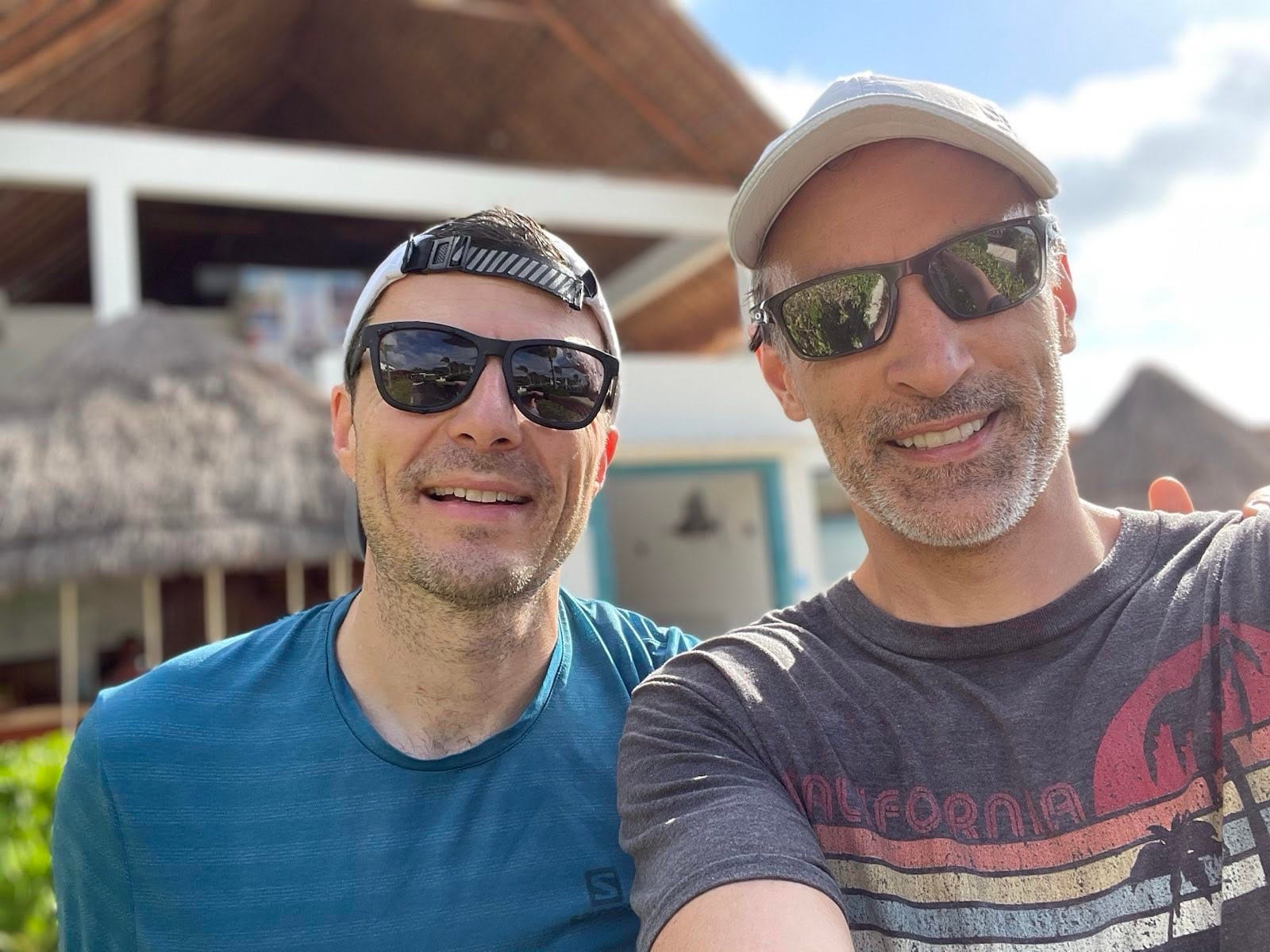
Several years later, we’re in Fort Lauderdale, sitting at a beachside café. The ocean moves in the background.
It’s been ten years since Phil’s Lyme diagnosis. He looks strong again. Lean. Focused.
“I’m glad you’re writing this story,” he says. “People need to know there’s hope with chronic pain. But it’s important to say that I’ve had a thousand setbacks. There’s no easy fix. If your story helps one person, it’s worth publishing it.”
He finishes his decaf coffee and stands up.
“Let’s go for a run,” he says.
We start along the beach path. The sun is low and the wind steady.
Twenty minutes in, I beg him to slow the pace.
My friend is back.
Endnotes
Asch, S. E. (1955). Opinions and social pressure. Scientific American, 193(5), 31–35. In his 1955 Scientific American article, Solomon Asch describes experiments showing that individuals will often conform to a clearly incorrect majority judgment about the length of lines, demonstrating the powerful effect of social pressure on independent perception and judgment.
Taleb, N. N. (2007). The Black Swan: The Impact of the Highly Improbable. Random House.
We rationalize away good decisions or let others in our circle of trust lead. The consequences can be significantly poor. I'm so happy to read that this story of your best friend has a happier ending. Phil suffered, endured and has risen from the ashes. He owns his life again.